
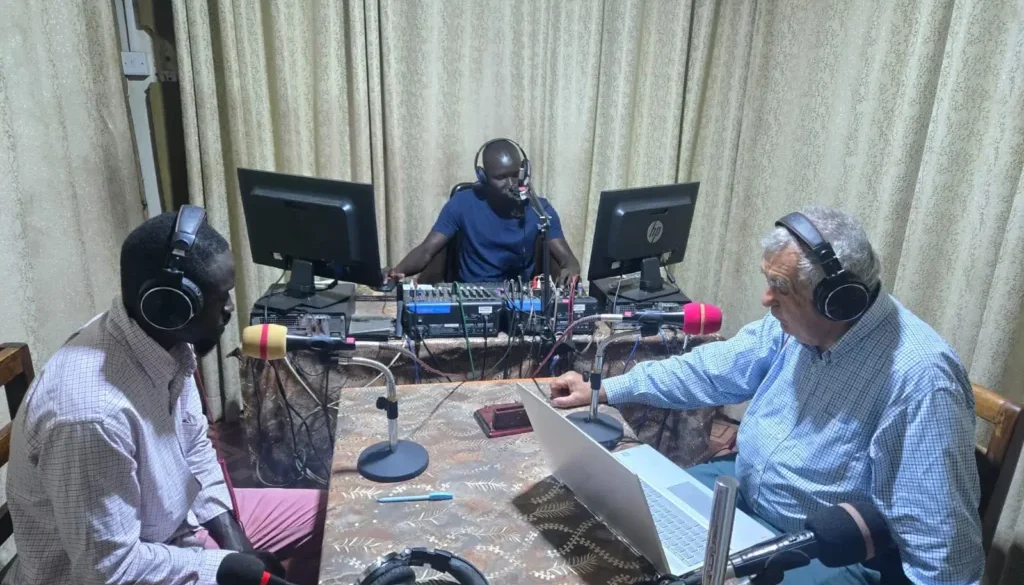
Christian Radio in South Sudan and Uganda: Impacts in the reagion
The role of Christian radio in South Sudan and Uganda
To understand why a broadcast ministry is needed in this region, one must first look at the severe challenges affecting local communities. The national educational and communication infrastructure in South Sudan has historically struggled to reach its full potential. Local systems are heavily hindered by systemic poverty, governmental failures, ongoing violence, and the generally poor health of citizens. Furthermore, the national government has frequently failed to protect, promote, and fulfill the basic right to health, while also restricting humanitarian access to vulnerable populations. Under these conditions, traditional methods of community gathering, news distribution, and spiritual education are highly restricted. Physical travel between isolated rural sectors is often dangerous or impossible due to localized conflict and seasonal flooding.
By utilizing the airwaves, RMC Ministries establishes a reliable, daily connection with communities that are otherwise cut off from the outside world. This digital presence provides a sense of stability and hope, proving that faith can indeed travel further than physical limitations allow.
The geography of dispersed communities and refugees
The physical coverage area of Imprint Radio is strategically designed to reach individuals who are navigating extreme displacement. The ongoing humanitarian crisis has forced hundreds of thousands of South Sudanese citizens to flee their homes, with many crossing the southern border to reside in refugee camps in Northern Uganda.
Serving Northern Uganda refugee camps
A major portion of the radio’s daily audience consists of South Sudanese refugees living in Northern Uganda. The broadcast signal reaches deep into several highly populated refugee settlements, including:
- Pagirinya refugee camp
- Majii refugee camp
- Boroli refugee camp
For these displaced individuals, tuning into the daily broadcast serves as a critical connection to their native language, their shared culture, and their homeland. It reminds them that they have not been forgotten by the global Christian community.
Reaching isolated Eastern Equatoria villages
Within South Sudan, the radio signal is broadcasted directly into the remote and rural villages of the Eastern Equatoria State. These isolated settlements include:
- Longu and Olikwi
- Biyo 1 and Biyo 2
- Matara and Buruwa
- Fuli East
Many of these rural communities are completely cut off from municipal services, public schools, and traditional church buildings. The absence of physical roads means that humanitarian aid and spiritual materials rarely reach these locations by land. By broadcasting across Eastern Equatoria, RMC Ministries ensures that geographic isolation does not prevent these communities from receiving spiritual and practical information.
Under the banner of Teach for Jesus Christ: Imprint Radio Operations
RMC Imprint Radio 101.5 FM operates under the clear, defining motto: “Teach for Jesus Christ.” Unlike commercial radio stations, the daily programming is curated specifically to address the spiritual, educational, and emotional needs of its listeners.
The station maintains a rigorous, demanding broadcast schedule, transmitting programs for 17 hours every single day, from 5:30 am in the morning until 8:30 pm at night, Monday through Sunday. This continuous presence ensures that listeners can access encouragement at any point during their daily routines.
The daily programming is divided into structured three-hour blocks. This format combines:
- Live scriptural teaching: Deep theological and biblical studies designed to ground listeners in their faith.
- Pre-recorded discipleship programs: Spiritual lessons and Christian music that can be broadcasted reliably throughout the day.
- Live calls: Interactive portions of the broadcast where listeners are invited to call the station directly to ask questions, share testimonies, and request prayer.
This consistent schedule provides a sense of routine and security for families living in highly unpredictable environments.
Impact 1: Overcoming physical boundaries to reach the unreached
The first proven impact of Christian radio in South Sudan and Uganda is its unique ability to overcome the physical and infrastructural boundaries that isolate rural populations. In South Sudan, physical travel is limited. Overcrowded communities, an absence of paved roads, and the high risk of seasonal flooding make establishing physical churches in every village an impossible task.
Furthermore, the educational system remains highly inaccessible for many, leaving a significant portion of the adult population unable to read printed materials. Radio broadcasting completely removes these barriers. It requires no physical roads to travel, costs nothing for the listener to receive, and is completely accessible to individuals of all literacy levels.
Overcoming the power grid deficit with solar-powered radios
A primary challenge of executing a broadcast ministry in East Africa is ensuring that the target audience actually possesses the equipment needed to listen. The vast majority of remote villages in Eastern Equatoria and refugee camps in Northern Uganda completely lack access to a central electrical grid. For an impoverished family, purchasing disposable batteries for a standard radio receiver is a financial impossibility.
To solve this logistical barrier, RMC Ministries facilitated the distribution of 3,000 solar-powered radios, which were generously donated by Galcom. These durable, solar-powered devices were distributed directly to families living in the refugee camps of Pagirinya, Majii, and Boroli, as well as the remote villages of Eastern Equatoria, including Longu, Biyo 1 & 2, Matara, Olikwi, Buruwa, and Fuli East.
Because these specialized radios do not require batteries or plug-in electricity, they cost families nothing to operate. Daily, hundreds of families gather around these solar devices to listen to Imprint Radio, transforming isolated homesteads into active, communal learning spaces.
Impact 2: Providing trauma counseling and family reconciliation
The second major impact of the radio ministry is the delivery of essential trauma counseling and social reconciliation services. Decades of civil conflict, forced displacement, and extreme poverty have left deep psychological scars on the population of South Sudan. Traditional counseling services are virtually nonexistent in rural areas and refugee settlements.
Imprint Radio fills this critical gap by employing presenters who are specifically trained to provide trauma-informed counseling over the airwaves. The broadcasts address sensitive topics such as grief, displacement, family separation, and community conflict.
The power of live audience interaction
The effectiveness of this trauma outreach is reflected in the high volume of live listener engagement. During a recent three-month reporting period, the station recorded significant interaction:
- 2,520 live phone calls: Listeners called the station to share their personal struggles, seek advice, and engage in open discussions.
- 720 specific prayer requests: Presenters took time during live broadcasts to pray for 720 individual needs submitted directly by the audience.
Through these live counseling and prayer segments, the station actively works to reconcile separated families, heal emotional trauma, and promote peace among the diverse ethnic communities residing in both South Sudan and Uganda.
Impact 3: delivering the gospel to those with no physical church
The third proven impact of the broadcast is the delivery of the Gospel to areas that have no physical church buildings or ordained pastors. During the years of civil conflict, many physical church structures in South Sudan were burned, abandoned, or destroyed. In many remote villages, there are simply no physical facilities available for Christian worship.
Imprint Radio functions as a virtual, regional church for thousands of families. Every morning and evening, families tune in to hear scriptural teaching, join in corporate prayer, and sing along with Christian worship music.
This virtual church model aligns perfectly with the biblical mandate of Matthew 25—to seek out, feed, and minister to those who are suffering and forgotten. By delivering the Gospel directly into the homes of those who cannot travel, the radio station ensures that the message of Christ reaches the absolute margins of society.
Integrating youth education with radio operations
The long-term sustainability of Imprint Radio is closely tied to RMC Ministries’ broader educational initiatives in South Sudan, specifically F.I.S.H. Academy. F.I.S.H. Academy is a secondary boarding school operated by the ministry in Nimule, which focuses on preparing students to be job creators rather than job seekers.
The academy’s curriculum is highly practical, providing students with completion certificates in:
- Information and communication technology (ICT): Utilizing a new computer lab to learn Windows 10 and 11 alongside standard Microsoft Office packages.
- Entrepreneurship skills: Preparing youth to establish independent local businesses.
- Vocational poultry & piggery management: Hands-on training through the school’s active chicken and pig farms.
Rather than graduating students and leaving them to navigate the stagnant local job market alone, RMC Ministries actively integrates its top-performing alumni directly into the operations of Imprint Radio.
Currently, the ministry has trained two former F.I.S.H. Academy students to work as professional, live presenters for Imprint Radio. This integration provides these young people with stable, dignified employment, while ensuring that the radio station is led by local voices who intimately understand the cultural nuances and challenges of their own communities.
Infrastructure challenges facing Christian Radio in South Sudan and Uganda
Maintaining a 17-hour daily broadcast in an area without a municipal power grid requires immense logistical coordination and financial support. Imprint Radio depends entirely on its own power generation equipment to keep its transmitter running.
Implementing sustainable power solutions
Historically, the radio station relied exclusively on a diesel generator, which required a weekly service schedule and consumed a substantial amount of expensive fuel. To improve operational sustainability and reduce overhead costs, RMC Ministries recently invested in high-capacity lithium batteries.
The ministry acquired two new 10KVA lithium batteries for the radio station. This infrastructural upgrade yielded immediate, measurable benefits:
- Reduction in fuel costs: Monthly generator fuel expenditures were reduced from $800 to $600.
- Stabilized signal: The transition to lithium battery power stabilized the electrical supply, resulting in a stronger, uninterrupted broadcast signal.
By reducing monthly operational costs, the ministry can redirect valuable resources toward expanding other vital programs, such as student scholarships and prison food aid.
Construction and prayer needs
While the station is currently operational, the physical infrastructure requires significant expansion to reach its full potential and secure its long-term future. Funds are raising for the following:
- Construct the Radio Tower: With the help of CMML US, the ministry finished the construction of its permanent, main Radio Tower & maximized its signal range across South Sudan and Uganda.
- Radio buildings: The organization is raising funds to finish construction of permanent facilities, specifically including a dedicated Transmitter Room to protect sensitive electrical equipment and a professional, soundproof Radio Studio for the presenters.
These projects will ensure that the station remains a permanent, secure fixture in the community for decades to come.
FAQ Section
How does Christian radio in South Sudan and Uganda reach people who do not have electricity? To resolve the absolute lack of municipal power grids in remote villages and refugee camps, RMC Ministries partnered with Galcom to distribute 3,000 solar-powered radios. These devices require no batteries or plug-in electricity, allowing families to listen to the daily broadcasts completely free of charge.
What are the exact locations that Imprint Radio broadcasts to? The broadcast signal reaches remote villages in the Eastern Equatoria State of South Sudan (including Longu, Biyo 1 & 2, Matara, Olikwi, Buruwa, and Fuli East), as well as several large refugee settlements in Northern Uganda (including Pagirinya, Majii, and Boroli camps).
What kind of support does the radio station provide beyond religious preaching? In addition to scriptural teaching, Imprint Radio serves as a social service. The presenters provide professional trauma counseling to communities affected by war, help reconcile separated families, and actively promote peace and ethnic unity among diverse local populations.
How does RMC Ministries power the radio station for 17 hours every day? The station relies on a generator that is serviced weekly, paired with two recently acquired 10KVA lithium batteries. This hybrid power system stabilized the electrical supply and reduced monthly generator fuel costs from $800 to $600.
What are the immediate infrastructure needs for the radio ministry? The ministry’s primary prayer needs include finishing a dedicated Transmitter Room to secure sensitive equipment, and construct a permanent, fully equipped Radio Studio.
Conclusion
Imprint Radio 101.5 FM is far more than a simple broadcasting station; it is a lifeline of hope, peace, and education for thousands of families surviving in the wake of severe humanitarian crises. By utilizing Christian radio in South Sudan and Uganda, RMC Ministries effectively bypasses the geographic and economic boundaries that keep remote populations isolated. Through the distribution of solar-powered radios & the delivery of live trauma counseling, the ministry is systematically transforming lives and building a sustainable foundation for spiritual and social growth across the country.
How you can help
The continuous, daily operation of Imprint Radio and the expansion of the F.I.S.H. Academy educational campus rely entirely on the generosity and prayers of external partners. Here is how you can take practical action today:
- Donate: Support the daily operations of the radio ministry. Your financial gifts help cover the $600 monthly generator fuel costs, maintain broadcasting equipment, and fund the daily operations of the station.
- Pray: Join RMC Ministries in praying for the dedicated staff members on the ground, the volunteer guards keeping the facilities safe, and the thousands of daily listeners tuning in from refugee camps and isolated villages.
- Sponsor: Directly sponsor a student’s education at F.I.S.H. Academy. Funding a scholarship provides a vulnerable young person with high-quality education and vocational training, while keeping young girls in a safe boarding environment protected from early forced marriage.
- Share the ministry: Help bring global awareness to the ongoing humanitarian crisis in South Sudan and Northern Uganda by sharing RMC’s mission, causes, and radio programs with your local church, family, social circles & on social media accounts.
- Support a specific project: Contribute directly to RMC’s immediate construction goals, such as building the permanent Transmitter Room.


