
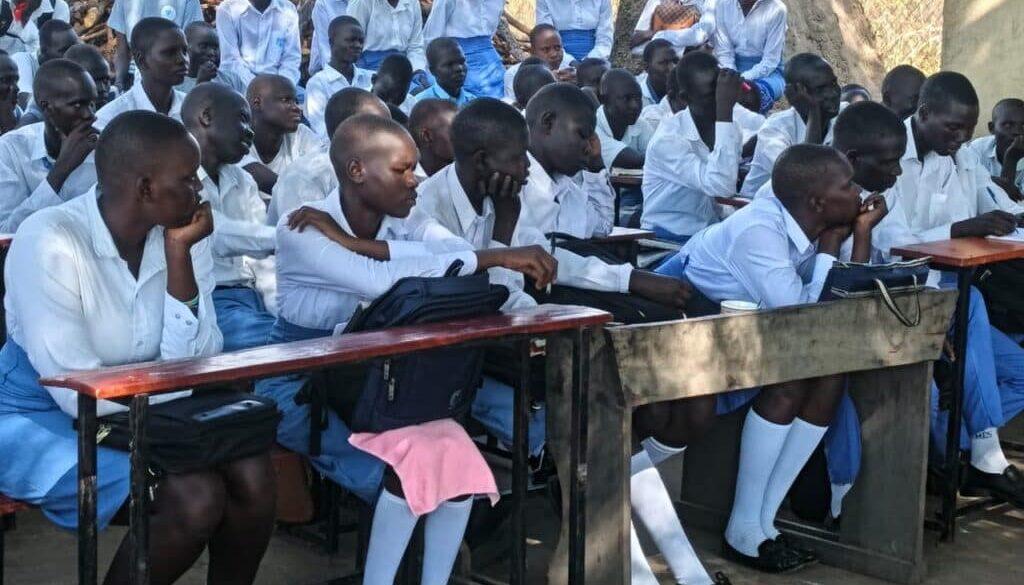
How F.I.S.H. Academy is transforming education in South Sudan
F.I.S.H. Academy is a Christian school in South Sudan that provides education, scholarships, vocational training, and safe boarding facilities for vulnerable children. By helping students remain in school and avoid forced marriage, the academy is creating opportunities that would otherwise be out of reach.
The severe crisis facing the South Sudan education system
The challenges hindering the South Sudan education system from reaching its full potential are systemic and vast. The national educational infrastructure is severely affected by poverty, historical governmental failures, and the consequences of ongoing violence. Furthermore, the general poor health of citizens and the geographical inaccessibility of many regions make consistent schooling a logistical hurdle.
When students can reach a school, they often find that the facilities are overcrowded, drastically underfunded, and operated by unqualified teachers. However, the most significant barrier to education is financial. The educational system within South Sudan is particularly challenging for less fortunate families because attending a public school is not free. The government mandates a specific cost per child, creating an immediate financial block.
Consequently, there are thousands of young children across the nation who simply do not have the financial means to pay for their schooling. Without intervention, these children remain trapped in a cycle of poverty. RMC Ministries recognized this gap and established F.I.S.H. Academy to provide high-quality, accessible education to students who would otherwise be entirely excluded from the system.
Navigating harmful cultural norms and gender roles
To understand the necessity of a dedicated Christian school in South Sudan, one must examine the societal conditions that dictate who is allowed to learn. Education remains largely inaccessible for women and girls due to a national dedication to maintaining traditional gender roles.
Gender inequality in South Sudan is heavily shaped by prevailing cultural norms and a rigid patriarchal society. Within this culture, men are viewed as the decision-makers and the main income earners, while women and girls are strictly seen as homemakers and childbearers. It is expected that young girls emulate their mother’s domestic behavior, leading to a strict gender division of labor. These harmful gender norms have left women marginalized and frequently excluded from participating in any level of political activity or community decision-making.
This social framework has led to a widespread religious and social norm that actively opposes female education. The consequences of this exclusion are severe, affecting girls’ livelihoods, their overall quality of life, and their future opportunities.
South Sudan forced marriage
Poverty and traditional customs intersect to create dangerous environments for young women. It is a long-standing cultural tradition for parents to marry their daughters off early in exchange for a dowry. In South Sudan, the arranged marriage of a young girl to an older man brings the girl’s family significant wealth, traditionally measured in livestock. A single girl can bring her family a dowry of up to 100 cows, with each cow valued at approximately $1,000.
Because families view their daughters as a source of wealth, they frequently refuse to pay for their school tuition or basic needs. Instead, girls face the immediate threat of South Sudan forced marriage. South Sudan has some of the highest rates of forced marriage and maternal mortality globally. Nearly half of all South Sudanese girls face the likelihood of forced or early marriage, with current statistics showing that 45% of girls are married before their 18th birthday.
Compounding this issue is the legal landscape. The Transitional Constitution of 2011 states that no marriage shall be entered into without free and full consent; however, in many tribes, this law is completely ignored. Furthermore, South Sudan is one of only six countries in the world—alongside Equatorial Guinea, Gambia, Saudi Arabia, Somalia, and Yemen—that does not specify a minimum legal age for marriage. Polygamy, specifically polygyny where a man can have multiple wives depending on his wealth, is also legal, prevalent, and widely accepted.
Education as protection: F.I.S.H. Academy education interventions
In response to these dire statistics, RMC Ministries approaches F.I.S.H. Academy education not merely as an opportunity, but primarily as physical and social protection. Providing girls with access to a classroom directly mitigates the risks associated with their cultural environment.
Data shows that girls who attend school experience a significantly lower risk of early marriage, early pregnancy, and sex crimes. Moreover, education breaks generational cycles of poverty and poor health; children born to educated mothers have a 50% higher chance of survival.
RMC Ministries scholarships for vulnerable youth
To ensure girls can access these protective benefits, RMC Ministries heavily subsidizes female enrollment. In 2024, the ministry successfully enrolled 450 vulnerable students into F.I.S.H. Academy, with an intentional demographic makeup of 80% girls.
Furthermore, the ministry directly supplied 45 highly vulnerable students with dedicated RMC Ministries scholarships. This scholarship cohort consisted of 36 girls and 9 boys. Many of these female students originated from the Nuba Mountains and were identified as being at high risk for forced marriage.
Between the years 2021 and 2025, a total of 325 girls successfully completed their high school education through the free scholarship program provided by the ministry. By keeping these young women in a secure boarding school environment, the ministry physically separates them from the immediate pressures of the dowry system, keeping them safe from parents who might otherwise force them into early marriages.
Curriculum focus: raising job creators
While a standard Christian school in South Sudan might focus solely on foundational academics and theology, F.I.S.H. Academy takes a strictly pragmatic approach to curriculum design. Unlike other local institutions, the academy remains the only school in its area dedicated to preparing students to be job creators rather than job seekers.
In December 2025, F.I.S.H. Academy proudly graduated a class of 79 students who completed their high school requirements. These graduates were thoroughly trained across multiple disciplines to ensure they could survive and generate income while waiting to join a university. The students received completion certificates verifying their training in several distinct areas:
- Information and Communication Technology (ICT): Students utilize the academy’s new computer lab to learn essential modern skills. They are specifically trained in operating Windows 10 and 11, as well as navigating standard Microsoft packages.
- Entrepreneurship Skills: Students are taught how to build and manage small businesses, equipping them for the realities of the local economy.
- Spiritual Leadership: As a faith-based institution, the school ensures students experience consistent spiritual growth alongside their academic pursuits.
- Poultry Management: Students engage in direct, hands-on agricultural training, learning how to raise and sell livestock.
Vocational training: the student-led poultry farm
To complement classroom theory with verifiable practice, F.I.S.H. Academy operates an on-site poultry farm. The farm is managed directly by the students as a core component of their vocational poultry management training.
In December 2025, the ministry stocked the farm with 100 new chicks. The students are responsible for raising these chicks until they are ready for market. Once matured, each chicken is sold for a price ranging between $8 and $10.
This project is highly successful and serves multiple operational purposes for the ministry. The revenue generated from poultry sales is strategically reinvested to maintain the school’s facilities, support the operations of RMC Imprint Radio, and purchase sustainable feed for the farm. Additionally, a portion of the chickens is utilized to provide a sustainable protein diet for the ministry staff working at both the school and the radio station.
Looking forward, the ministry plans to significantly expand the poultry project to generate increased sustainable income. As part of this planned advancement toward self-sustainability, F.I.S.H. Academy also intends to start a new piggery project.
Enhancing campus infrastructure for the future
As the reputation of this Christian school in South Sudan grows, so does the demand for enrollment. The ministry currently faces a pressing need for spatial expansion. Because enrollment applications are steadily increasing, physical space on the campus has become highly limited.
To safely accommodate the growing student body, RMC Ministries is actively seeking funds to expand its current dormitory facilities. Expanding these dormitories is a critical priority, as the boarding environment is what keeps vulnerable young girls safe from forced marriages. Alongside the sleeping quarters, the ministry also plans to increase the square footage of its kitchen and cafeteria spaces to properly feed the expanded student population.
Providing clean water for Anzara
In addition to building expansions, the ministry is improving its foundational infrastructure. In February 2026, RMC Ministries successfully drilled a new water borehole to a depth of 65 meters at the ministry premises in Anzara.
The goal of this project is to provide a reliable source of clean, safe drinking water for both the F.I.S.H. Academy students and the surrounding community. The physical drilling is complete, but the ministry is currently seeking the funds necessary to motorize the well. Once motorized, this single borehole will easily provide clean water to thousands of people, drastically reducing the occurrence of waterborne diseases. It will also ease the daily physical burden on families, particularly women and children, who traditionally must walk long, dangerous distances to fetch water.
FAQ
Why do children in South Sudan struggle to access education?
The education system in South Sudan is heavily affected by poverty, ongoing violence, and governmental failures. Public schools are not free; the government charges a cost per child, which prevents thousands of impoverished children from enrolling. The schools that do exist are frequently overcrowded, underfunded, and staffed by unqualified teachers.
How does F.I.S.H. Academy protect young girls?
In South Sudan, girls are often viewed as a source of wealth through a dowry system where they are married off to older men for up to 100 cows. 45% of girls are married before they turn 18. F.I.S.H. Academy provides free scholarships and a safe boarding school environment that physically separates vulnerable girls from the pressures of early, forced marriage.
What skills do students learn at F.I.S.H. Academy?
The academy prepares students to be job creators. Alongside traditional academics, students receive certificates for training in Information and Communication Technology (ICT) using a new computer lab, entrepreneurship skills, spiritual leadership, and practical poultry management.
What is the F.I.S.H. Academy poultry project?
As part of their vocational training, students manage an on-site poultry farm. Recently stocked with 100 chicks, the chickens are raised and sold for $8 to $10 each. The generated revenue supports the school, funds the ministry’s radio station, buys animal feed, and provides a sustainable diet for the staff.
How is the school preparing for future growth?
Due to increasing enrollment applications, the school is seeking to expand its dormitories, kitchen, and cafeteria spaces to accommodate more students. Additionally, the ministry recently drilled a new 65-meter water borehole on the premises to provide clean water for the students and the surrounding Anzara community.


